
• Skip to main content
Contact Newsletter
🤝 Support Our Work 🔗 Allies & Resources
True Signal Media
  • Home
  • Investigations
  • Daily Brief
  • Signal Dispatch
  • About True Signal Media
  • FOIA Tools
  • Meet the Team
  • Cookie Policy (EU)
Submit a Tip

By David Burger - Director
Published: January 8, 2026 Reading Time: 20 Min Read
Location: Federal Level, Ghana, International (Non-US), Togo, West Africa
Page 1 of 7

When Systems Fail: Two Continents, One Pattern of Abandonment

Location

  • Federal Level
  • Ghana
  • International (Non-US)
  • Togo
  • West Africa

The Desk of Controlled Chaos

I’m managing two nonprofits (Covenant for Forgotten Warriors and True Signal Media), agricultural operations across an ocean in Ghana, 180+ active FOIA requests and 30+ appeals targeting government stonewalling at every level. Why? Because I’ve learned the same lesson on two continents: when official systems fail citizens, citizens must organize to save themselves.

I’ve won court victories in Ghana that sent illegal miners home. In America, I’ve filed 180+ FOIA requests, 30+ appeals, and I’m building congressional oversight cases. The tools are different. My willingness to take officials to court is not.

Corruption isn’t just about bribes changing hands. It’s about any system where officials prioritize their interests over their duty to citizens – whether the currency is cash or career protection. I’ve seen both. The betrayal looks identical.


Ghana: When Promises Meet Reality

The Promise

Across Berekum District and other districts throughout Ghana, Chinese mining operations approached farmers with compelling offers: lease or sell your land, receive payment that could transform your family’s economic situation. For farmers working land that had supported generations, it seemed like opportunity.

The pitch was appealing – let us use your land to extract minerals, you get paid, everyone benefits. Many farmers imagined something manageable. Careful extraction. Targeted operations. Land that could eventually return to agricultural use. They signed agreements thinking they were making smart business decisions for their families.

Harvested Cocoa Pods
Cocoa harvest from productive agricultural land in the Berekum District. This is what the land produces when used for its intended purpose – the economic engine that Chinese mining operations destroyed.

This is the reality of Ghanaian agricultural land – fertile, productive, capable of supporting families for generations. Cocoa farms. Real economic value. This is what the mining sites used to be.
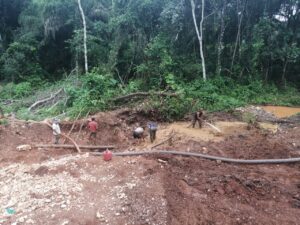
Large Scale Mining Operation
Industrial mining operations in Ghana’s Berekum District. This is what “careful extraction” actually looked like.

This is what mining actually meant. Not careful extraction – industrial-scale devastation.

By the time farmers understood what they’d agreed to, the equipment was already destroying their land. The topsoil – built up over centuries – stripped away. Water sources contaminated with mining runoff. Deep pits carved into land that once grew crops.
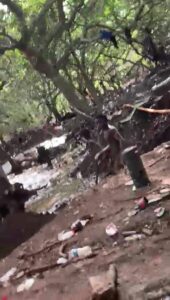
Hand-digging operation at a mining site. Ghanaian laborers excavating 3-4 feet deep around existing trees. This wasn’t mechanized efficiency – this was systematic destruction using local labor.

The operations employed Ghanaian men to help dig and destroy the land – turning neighbors into accomplices in the destruction of their own district’s agricultural future. Local labor, foreign profit, permanent devastation. Hand-digging 3-4 feet deep around trees, destroying root systems and soil structure.
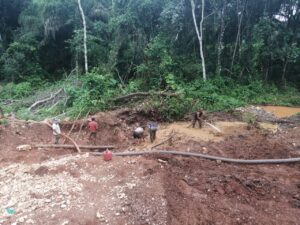
The aftermath: land rendered permanently unusable for agriculture. This isn’t temporary disruption – it’s permanent transformation.

The money they’d been promised suddenly looked very different against the reality of what they’d lost. This wasn’t land that could be “restored” after mining. This was permanent destruction.

Instead, they targeted farmers. They approached people working productive agricultural land with incomplete information about what “mining” actually meant. They used Ghanaian labor to dig and destroy. They turned productive farmland into permanent wasteland when legitimate alternatives existed.

This wasn’t about necessity. This was about exploitation. Farmers were easier targets than legitimate mining land purchases. Less informed. Less able to fight back. More vulnerable to promises of quick money without understanding the permanent cost.

And here’s what made it worse: many farmers who tried to stop the operations once they understood the reality found themselves bound by the contracts they’d signed. Agreements made under incomplete information became legal shields for continued destruction.

← Previous
1 2 3 4 5 6 7
Next →

Table of Contents

Page 1 When Systems Fail: Two Continents, One Pattern of Abandonment Page 2 When Citizens Had to Fight Back Page 3 America: Career Protection Over Duty Page 4 Two Systems, One Disease Page 5 Why This Matters: The Accountability Crisis Page 6 Solutions: What Actually Works Page 7 The Fight That Never Ends
← Abandoned: Part 3 - The November 11 Assault Investigation Index Abandoned: Part 4 - The Fictitious Veteran Who Got Assaulted: State Department Caught Manufacturing Evidence →
Location: Federal Level, Ghana, International (Non-US), Togo, West Africa

True Signal Media Logo
TRUE SIGNAL MEDIA
INDEPENDENT. UNFILTERED. RELENTLESSLY CLEAR.
SUPPORT OUR WORK
  • FOUNDING MEMBERS
  • GENERAL DONATION
  • MONTHLY SUPPORT
SITE INFORMATION
  • ACCESSIBILITY
  • COOKIE POLICY
  • TERMS OF USE
  • PRIVACY POLICY
"BECAUSE ACCOUNTABILITY JOURNALISM ISN'T DEAD — IT'S BEEN SYSTEMATICALLY OBSTRUCTED.
TRUE SIGNAL MEDIA EXISTS TO BREAK THE OBSTRUCTION."
© 2026 TRUE SIGNAL MEDIA — ALL RIGHTS RESERVED

Manage Consent

We use cookies to deliver our investigations and understand what matters to readers. We don't sell your data. You control your privacy settings.

Functional Always active
The technical storage or access is strictly necessary for the legitimate purpose of enabling the use of a specific service explicitly requested by the subscriber or user, or for the sole purpose of carrying out the transmission of a communication over an electronic communications network.
Preferences
The technical storage or access is necessary for the legitimate purpose of storing preferences that are not requested by the subscriber or user.
Statistics
The technical storage or access that is used exclusively for statistical purposes. The technical storage or access that is used exclusively for anonymous statistical purposes. Without a subpoena, voluntary compliance on the part of your Internet Service Provider, or additional records from a third party, information stored or retrieved for this purpose alone cannot usually be used to identify you.
Marketing
The technical storage or access is required to create user profiles to send advertising, or to track the user on a website or across several websites for similar marketing purposes.
  • Manage options
  • Manage services
  • Manage {vendor_count} vendors
  • Read more about these purposes
View preferences
  • {title}
  • {title}
  • {title}